
Red light therapy vs sunlight, and what actually differs
By Delfin Ward, Co-founder
Published · Updated
Red light therapy and sunlight both put light on your skin, and that's about where the likeness ends. A red light panel gives off a narrow band of red and near-infrared light, at the same dose every time, with no ultraviolet in it. Sunlight is every wavelength at once, ultraviolet included, at whatever strength the day brings. Nearly everything else follows from that.
What's actually in the light?
A red light panel is built to give off one narrow slice of the spectrum: red light you can see, and near-infrared just past it that you can't. That's all that comes out of it.
Sunlight is the whole spectrum at once. Visible light, infrared, and ultraviolet (UV), all together, in proportions that change through the day.
Red light and sunlight, side by side
| Red light panel | Sunlight | |
|---|---|---|
| What's in it | Red and near-infrared light only | Every wavelength, including UV |
| Ultraviolet | None | Yes: the part that tans you, burns you and carries the skin cancer risk |
| Vitamin D | No | Yes, your skin makes it from UV |
| Dose | The same every session | Changes with the hour, the season and the clouds |
| What you feel | A mild warmth | Depends on the day |
Why does the UV matter so much?
Because that's where the risk is. UV is the part of sunlight that tans you, burns you and carries the skin cancer risk. A red light panel has none of it.
UV is also the useful part for one thing: your skin makes vitamin D from it. A panel doesn't do that, so red light isn't a stand-in for getting outside.
Can you control the dose?
With a panel, yes. Same light, same distance, same few minutes, every time you come in.
With sunlight, not really. The strength changes with the time of day, the time of year and the weather, which is exactly why it's hard to get a steady, predictable amount of it.
How is red light supposed to work?
The working theory is that the cells in your skin and muscle absorb this light, the mitochondria in particular, the parts of a cell that make its energy. It's a theory researchers are still testing, so treat it as the idea behind the panel rather than a settled fact.
What does the research say it's good for?
For what we care about, recovery after hard training, the best evidence is one head-to-head. A 2022 review of four small trials, 66 people in all, tested red light against cold therapy, and red light came out ahead for strength recovery and soreness. The reviewers rated their own certainty moderate to very low, so it's a lean, not a verdict.
You'll see a much longer list of uses online. We only put on our site what we've read the studies for, and here's where those studies stop.
Trying it at Generator
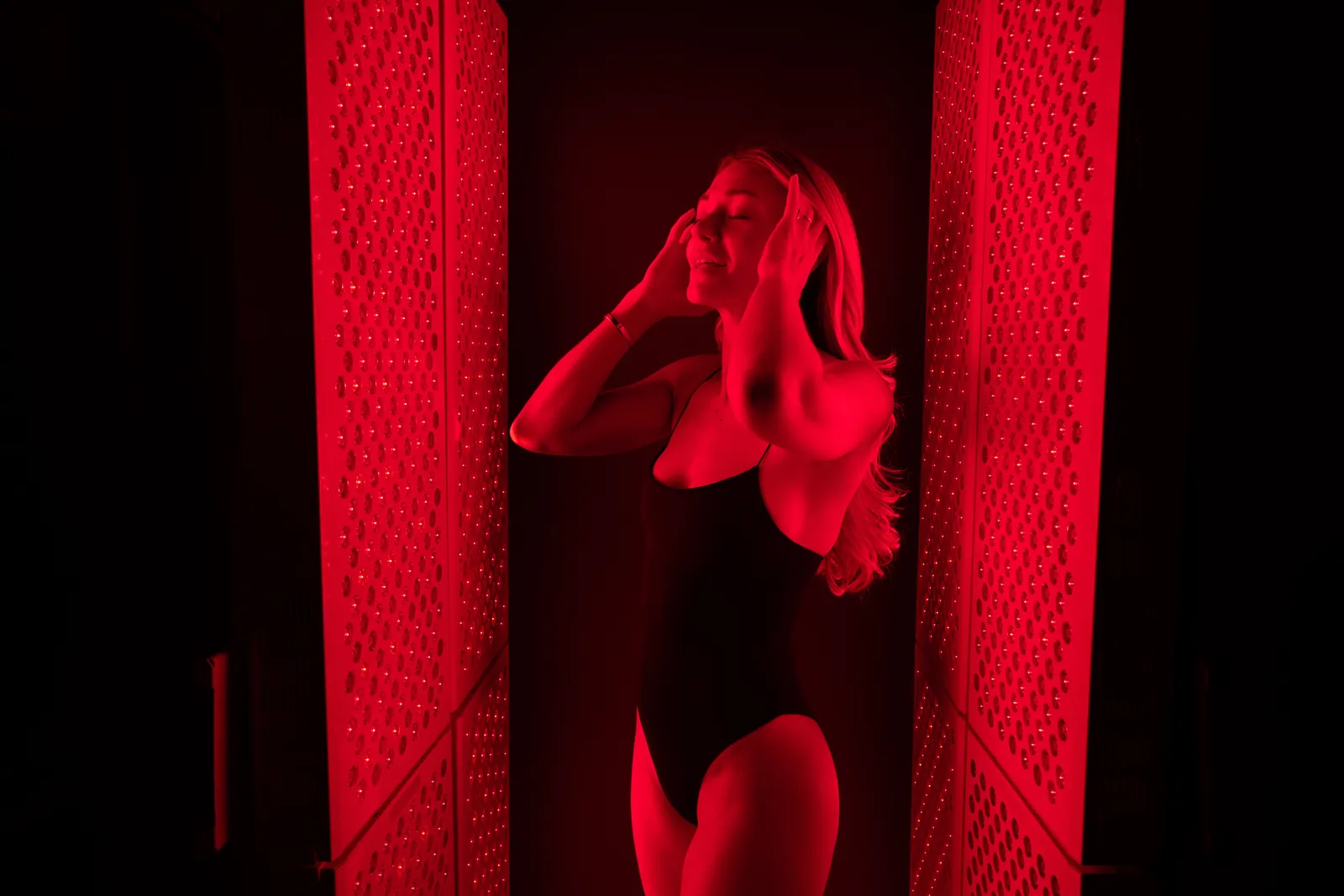
At our South Lamar studio, red light therapy is a few minutes in front of the panel, and most people add it to the end of a visit they were already booking. If you're doing the protocol, add it at the end.
Generator is a recovery studio, not a medical provider. Nothing here diagnoses or treats a condition. If you're pregnant, have a condition that makes you sensitive to light, or take medication that does, check with your doctor before you book.
Sources
Red light and sunlight, the short answers
Is red light therapy the same as sunlight?
Does red light therapy have UV in it?
Does red light therapy give you vitamin D?
Try red light at the end of your next visit
A few minutes in front of the panel, a mild warmth, and nothing to brace for.